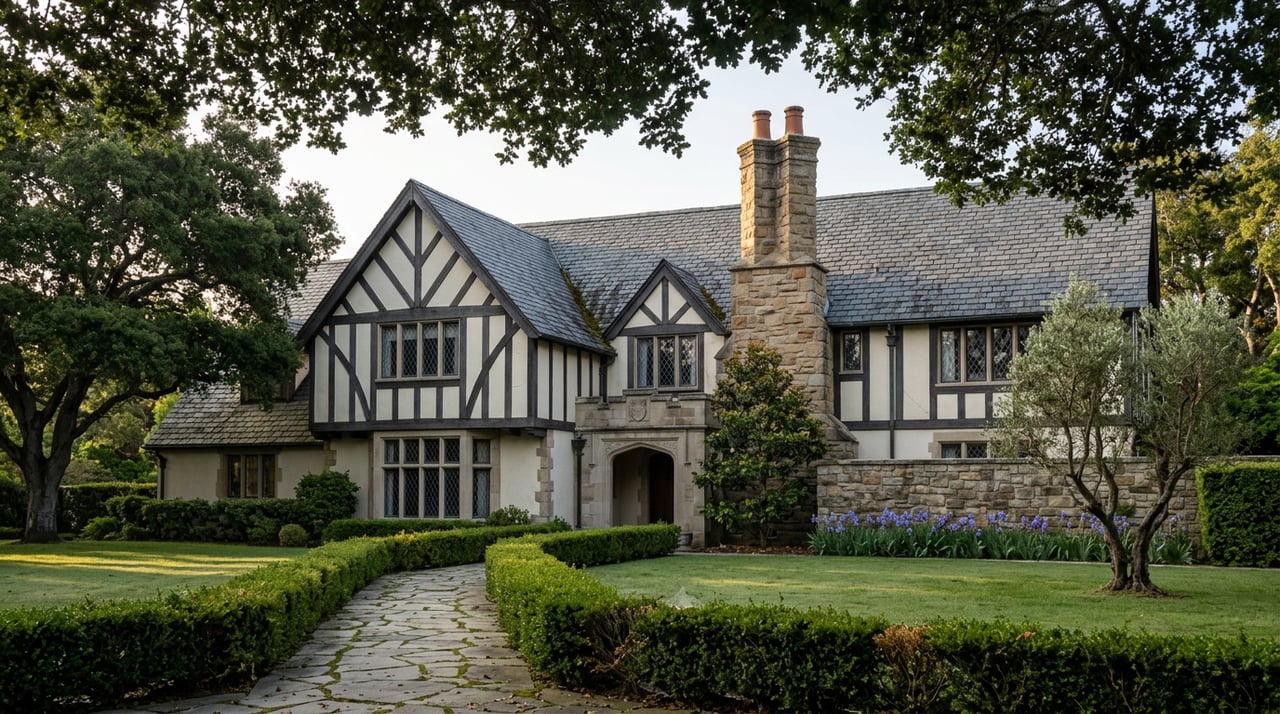
When Anthony Davis closed the sale of his Bel Air mansion this July, the final number was memorable for the wrong reason. The Lakers-turned-Wizards forward listed the house on Stratford Circle, which spans more than 17,000 square feet, at $39.9 million, took a sale at $32 million roughly eleven months later, and then wrote a check to the City of Los Angeles for close to $1.8 million on top of that. He had bought the property in 2021 for $31 million. After the tax, he walked away with less than he paid for it five years earlier.
That $1.8 million did not disappear into escrow fees or agent commissions. It went to the city because Measure ULA, Los Angeles's transfer tax on high-value real estate, charges 4 percent on the portion of a sale between $5.4 million and $10.9 million and 5.5 percent on anything above that, according to reporting by The Real Deal. Davis's house sits inside Los Angeles city limits. Had the same house sat a few blocks south in the city of Beverly Hills, which governs itself and sits outside LA's tax code entirely, none of that $1.8 million would have applied.
That distinction is the piece missing from most of what gets published about Bel Air's market right now.
The number everyone is quoting, and why it's the wrong one
Listing-portal data for August 2026 put the median asking price for the broader "Bel Air-Beverly Crest" market area at $3.5 million, down 22 percent from the same month a year earlier. Read on its own, that looks like a market losing altitude. But that figure blends estate-scale Bel Air homes with smaller, less expensive properties in the flatter Beverly Crest section next door, and it moves before you get anywhere near the neighborhood's true luxury inventory. Narrow the geography to Bel Air alone and the picture changes: the same portal's July 2026 listing data put the median asking price closer to $7.49 million, while recent closed-sale figures put the median sold price nearer $3.25 million. Three numbers, three different stories, all describing the same few square miles.
The gap between what Bel Air sellers ask and what Bel Air sellers actually get is not a rounding error. It is wide enough that a buyer using any single one of those figures to size up the neighborhood would be wrong by millions.
A falling median and a rising luxury market can both be true in Bel Air at the same time. They are not contradicting each other. They are describing two different tax jurisdictions that happen to share a reputation.
Because while headline medians slid, the top of the market did the opposite. Deals above $10 million rose more than 50 percent in 2025 compared with the year before, according to Compass data reported by The Wall Street Journal and cited in The Real Deal's coverage of the Westside luxury market. The ultra-high end is not contracting. It is the blended median, stirring together estate-scale sales with smaller lots in the flatter, more modest sections of "Beverly Crest," that makes the whole neighborhood look softer than any individual price tier actually is.
What Measure ULA is actually doing to this specific market
Bel Air and Holmby Hills are both residential neighborhoods that sit fully inside the city limits of Los Angeles, which means every closing in either one is subject to Measure ULA without exception. Beverly Hills, despite sharing a zip code boundary and a real estate reputation with both, is its own incorporated city with its own government, and Measure ULA is a Los Angeles municipal ordinance. It has no reach there.
That single fact of municipal geography is now showing up in the numbers. The Real Deal reported in early August 2026 that zip code 90077, which covers Bel Air, Holmby Hills, and Beverly Glen, has generated a cumulative $98 million in ULA revenue across 108 transactions. That is not a projection. It is money that has already left sellers' proceeds and landed in the city's affordable housing fund, on deals that, had they closed a few blocks over, would have kept that money in the transaction.
Here is how the three neighborhoods that make up what agents call the Platinum Triangle actually differ once you set reputation aside and look at jurisdiction:
| Neighborhood | Governing city | Subject to Measure ULA | What that means in practice |
|---|---|---|---|
| Bel Air | City of Los Angeles | Yes | 4% tax on the $5.4M-$10.9M portion of a sale, 5.5% above $10.9M |
| Holmby Hills | City of Los Angeles | Yes | Same tiers as Bel Air; no carve-out for estate-scale lots |
| Beverly Hills | City of Beverly Hills (independent) | No | Transfer costs are limited to standard county and state fees |
That table is the whole story in miniature. Two neighborhoods in the Platinum Triangle absorb a tax that the third does not, and sellers are pricing, timing, and structuring deals around that difference in ways that a single median can't capture.
How sellers are actually behaving around the tax tiers
The pattern shows up house by house once you start looking for it. British developer Nick Candy first listed his Holmby Hills estate in July 2022 at $85 million. After pulling it off the market last November, he relisted it this spring at $58 million, a reduction that moves the property well clear of aspirational pricing and into a range where a buyer's math is less punishing.
A few miles away, a 1939 Georgian mansion on Bellagio Road, gutted and reimagined inside by designer Kelly Wearstler, is asking $34.5 million this spring, down from $37.5 million last year. The seller bought the house in 1995 for $5.1 million, so even after ULA's bite at closing, the math still works in their favor. That is a different calculation than Davis faced, and it shows why blanket statements about "the luxury market" in Bel Air or Holmby Hills miss how much the outcome depends on a seller's basis, not just the asking price.
Then there is the Holmby Hills estate once owned by Barbara Stanwyck and Robert Taylor, which returned to market this month asking $39.95 million. Old Hollywood provenance and nine bedrooms of hand-hewn beams and wrought iron do not make the transfer tax go away. They do widen the pool of buyers willing to absorb it, which is a different kind of resilience than price alone measures.
None of these are distressed sales. They are sellers recalibrating around a cost that did not exist in this form before the current thresholds took hold, in a market where the buyer pool for a $40 million house is small enough globally that patience, not urgency, sets the pace.
What this means if you're actually comparing neighborhoods
If you are weighing Bel Air against Holmby Hills against Beverly Hills, the practical takeaway is not that one neighborhood is cheaper than the others. It is that the same asking price behaves differently depending on which side of the city line it sits.
A house asking $10.8 million in Bel Air and a house asking $11.2 million in Beverly Hills are not really $400,000 apart. Once ULA applies to the first and not the second, the effective gap for the seller's net proceeds, and often for how a deal gets negotiated near that threshold, is considerably larger. Buyers who understand this ask sharper questions about how a listing is priced relative to the $5.4 million and $10.9 million tiers, because sellers on the Los Angeles side of the boundary are often pricing with those cliffs already in mind.
For sellers, the lesson from Davis's sale is straightforward: know your basis and your tax exposure before you set an asking price, not after an offer arrives. For buyers, the lesson is to ask for actual closed comparables segmented by price tier, not a blended neighborhood median, because in Bel Air right now that median is doing more to obscure the market than describe it.
FAQ
Who actually pays Measure ULA, the buyer or the seller? The tax is technically paid by the seller at closing, but at this price point it shapes negotiation on both sides, since a buyer who understands the seller's exposure has real leverage near the tax thresholds.
Is there any chance Measure ULA changes for properties like these? The tax remains politically contested. In August 2026, the Los Angeles City Council voted to let voters decide in November whether to exempt Pacific Palisades fire victims from ULA for five years, a sign that carve-outs and adjustments to the ordinance are still very much in play even as its core rates hold for now.
Does Holmby Hills get any different treatment than Bel Air? No. Both sit inside Los Angeles city limits rather than being their own incorporated cities, so both are fully subject to the same ULA tiers. The only neighborhood in the Platinum Triangle with a structural exemption is Beverly Hills itself, by virtue of being its own city.
If you are trying to make sense of what a number like this actually means for a specific address, that is exactly the kind of read the George Penner Team does for clients across the Platinum Triangle every week. Contact Us to talk through where your search or your listing actually falls relative to these thresholds before you price against a median that may not be describing your corner of the market at all.